01.Challenge
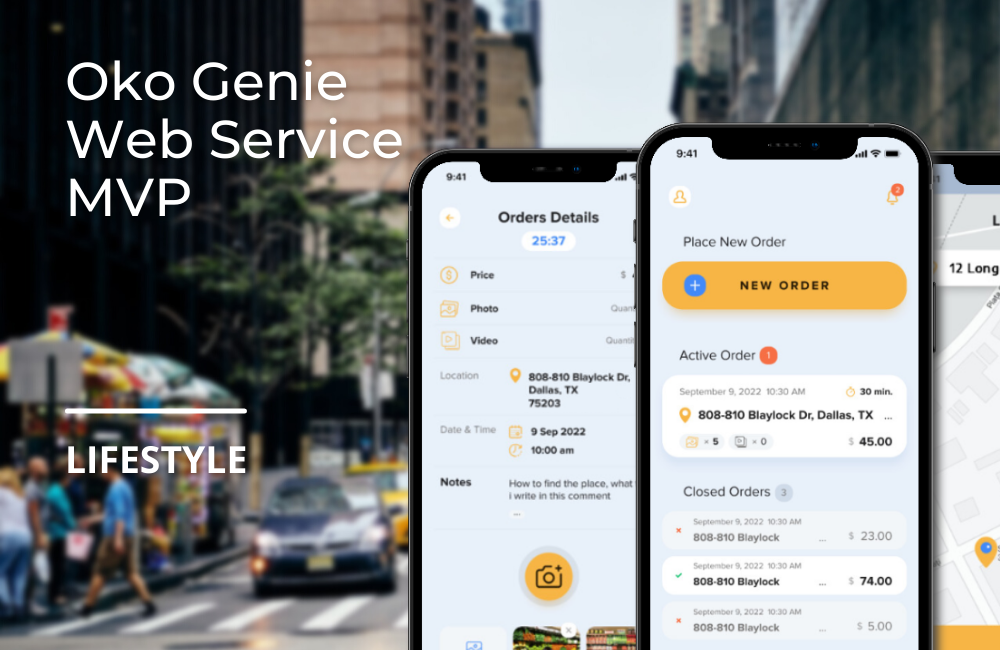
Oko Genie is a web service for modern gig economy that connects clients and service providers. Unlike other marketplaces and directories that match freelancers with local to-do requests, Oko Genie is fully anonymous and doesn't allow direct interaction between clients and service providers. The service is intended to be mobile-first, with web version to be added on later stages.
The client requested to develop MVP of the entire service from scratch, sharing only its basic idea and vision.
02.Research
During several client interview sessions our team has gathered the required details of the main user scenarios and required functionality details of the service. As the result, main business flows were developed, allowing software architect to build the core system accordingly.
03.UI/UX Prototyping
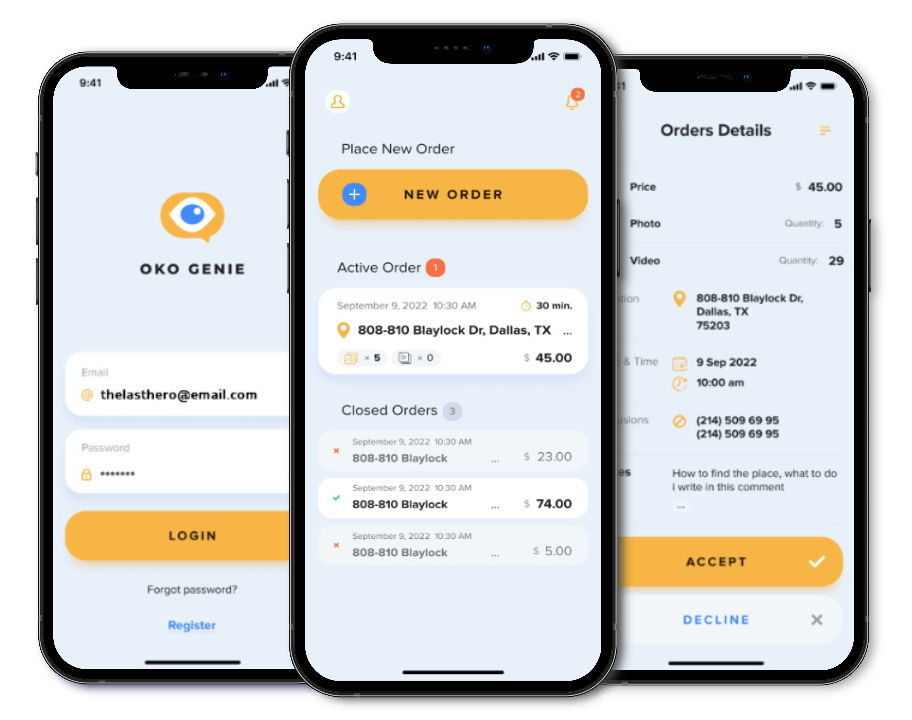
The next step was to develop user interface of the mobile application in form of wireframes and mockups. Then, the user flows of both Client and Provider user types were designed in clickable prototypes allowing to walk through the entire order flow from placing to confirming its completion.
04.GUI Design
Once wireframes and user flows were approved, we developed user interface design of the mobile application. After several rounds of corrections and color palette adjustments, GUI design has got its final look.
In addition to GUI design, the logo and app icons were designed to provide the full set of graphic assets.
03.Solution
We developed MVP of the service that included the core back-end application, implementation of the main business logic, and mobile applications on iOS and Android platforms. Core application enables all basic platform features, with an option to expand its functionality upon request.
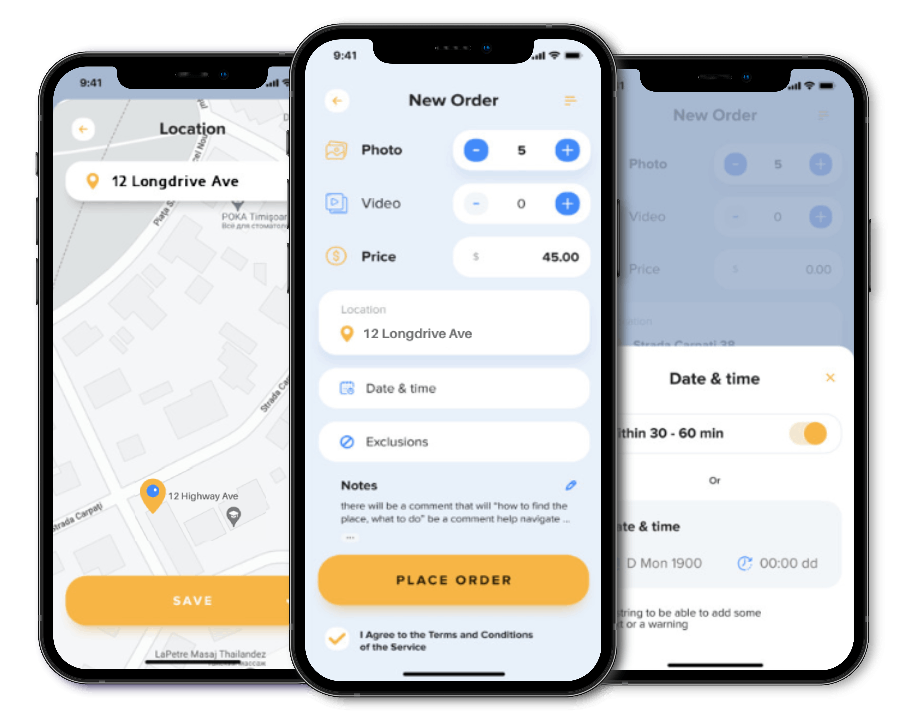
When the client creates an order, he needs to specify the desired quantity of footage materials, pick a location on the map, and deadline or exact time of the occasion. He also specifies the price he is willing to pay for the order, and the payment is secured by the Service.
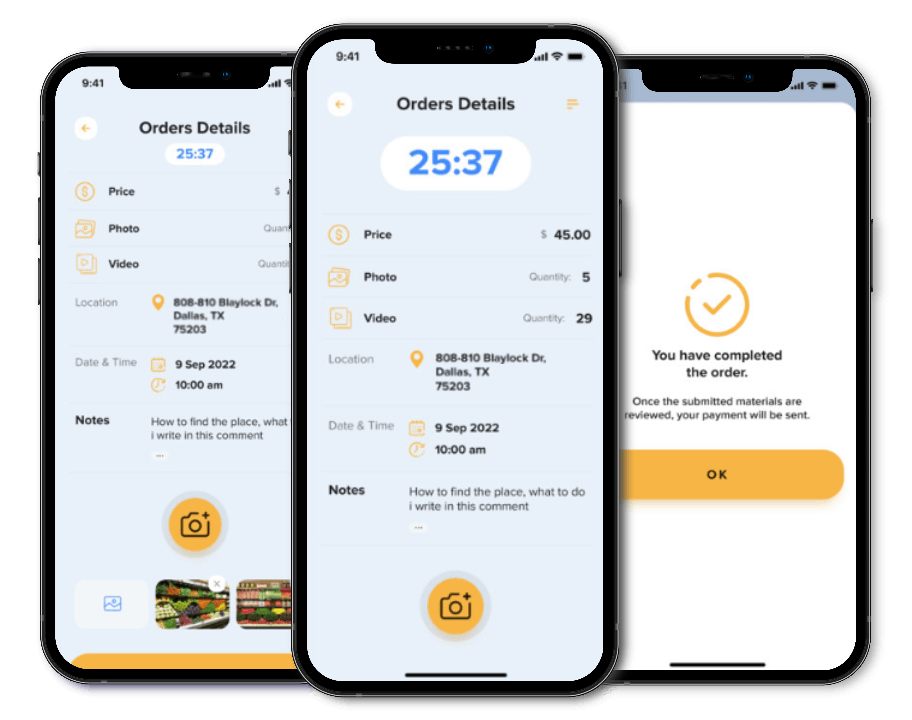
Due to the anonymous nature of the service, the client does not pick the provider: the system makes a list of potential providers, and ranks them basing on nearest location, current availability, rating, and other conditions. Push notification is sent to the provider with highest rank, and if he accepts the order, it is being assigned to him.
When the provider gets to the location and fulfills the task, all footage materials are sent directly to the client (with an optional feature of preliminary review by the Service administrator): they are not stored on providers' device, nor on the server.
04.Main Features
- Single application for client and service provider
- Single user account for client and service provider roles
- The Client is able to set the required quantity of footage materials (photos and videos)
- The Client is able to set the required timeframe to complete the order
- Provider is able to set his availability to service
- Both Client and Provider can browse the details of completed orders
- Provider is warned when the lead time is nearing the end of the order
- Potential providers are searched automatically basing on their availability and location
- Footage materials are not stored on Providers' device, nor on the server, so that the Client is their only owner